Français
 Español
 Italiano
 Deutsch
 Português
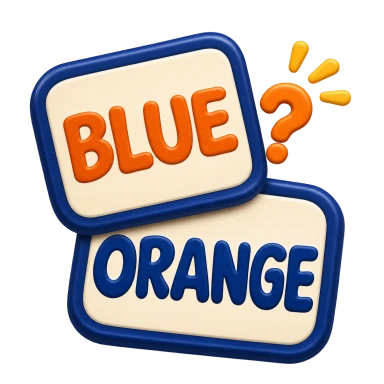
Color or Word? The Stroop effect brain game
The word “RED” written in blue? Tap the color of the ink, not the word you read! Easier said than done: your brain reads faster than it looks. 20 words per game, three levels, with or without a timer.
New record!
With a keyboard, answer with the keys 1, 2, 3… Untick “Timer” to play without rushing.
How to play Color or Word?
Goal A color name appears, written in another color: tap the color of the ink, not the word.
Step by step
Look at the ink, not the word: here the word says RED, but it is written in blue.
Tap the matching color among the buttons, or press its number key.
Hard level: sometimes the rule switches and you must tap the color written. Read the instruction above the word.
What you see
- Right answer: one point, next word.
- Wrong answer: the word shakes, no point.
- 20 words per game, with your record per level.
Tip. Blur your eyes slightly, or look at the edge of the letters: you see the color before you read the word.
Examples
The word says GREEN, the ink is red: tap red.
The instruction says “tap the color WRITTEN”: this time, tap blue.
What is the Stroop effect?
In 1935, the American psychologist John Ridley Stroop showed that naming the ink color of a word takes longer, and causes more mistakes, when the word names another color. Reading has become automatic: the brain reads the word before it looks at the color, and has to hold that reflex back. The game trains this focus, called selective attention.
Colors before words
This little game is a nice warm-up before a coloring session: it makes you look at colors instead of reading names. Children who know how to read can play from about 7 with three colors; the Hard level, where the rule sometimes switches to the written color, challenges adults too.
Color or Word?: questions and answers
Why is it so hard?
Because reading has become automatic: the brain reads the word before it looks at the color. You have to concentrate to ignore the word. This is the Stroop effect, described in 1935.
What if I find some colors hard to tell apart?
Each button also shows the color’s name. If some colors are still hard to tell apart, play the Easy level, which uses only three.
Do you need to be able to read?
Yes, the game is based on reading color names: it suits children from about 7.
How are answers scored?
Each of the 20 questions has one attempt. A correct answer earns one point; an incorrect answer earns zero, then the game advances. The timer is enabled by default but can be switched off before playing.
Is my record saved?
Yes. Your best score is kept in this browser for each level, with and without the timer.
More color games
Try Color Mix, Rainbow Path, Coloring Memory, or see all our activities and games.