Français
 Español
 Italiano
 Deutsch
 Português
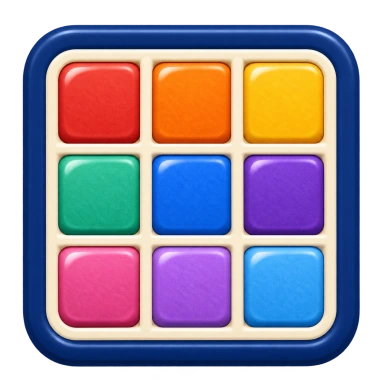
Color sudoku: a sudoku with colors instead of numbers
Each number becomes a color. Place the nine colors so that each one appears once in every row, column and box: when the grid is complete, it turns into a colorful mosaic. Four levels, from easy to expert. You can also play the classic sudoku, with numbers.
Puzzle solved!
How to play color sudoku
Goal Place nine colors so that each color appears once in every row, every column and every 3×3 box.
Step by step
Select an empty square, then tap a color in the palette.
Look around it: the colors already in its row, column and box cannot go there.
Place the only color left. When you hesitate, add notes: small dots of the possible colors.
What you see
- Given color: part of the puzzle, it cannot change.
- Your color: tap it again or use Erase to remove it.
- Clash: the same color twice in a row, column or box.
Tip. Turn on Numbers if two shades look alike to you: each color then shows its number from 1 to 9.
Examples
Three colors are already in this row: the free square takes the fourth one.
The lines fade and the 81 squares become a mosaic of nine colors.
A sudoku you can print and color
Click Print to color to get the grid on paper, with numbers and a color key. Solve it with a pencil, then color each square with the color of its number: the solved sudoku becomes a coloring page, a mosaic that is different for every puzzle.
For more patterns to color, browse our mandala coloring pages.
Color sudoku: questions and answers
What is a color sudoku?
A sudoku where the numbers 1 to 9 are replaced by nine colors. Each color must appear once in every row, every column and every 3×3 box.
Is it easier than a classic sudoku?
The logic is exactly the same. Colors offer a different visual presentation; they do not make the deductions easier. Start with Easy, and turn on Numbers whenever useful.
What if I cannot tell two colors apart?
Turn on Numbers: each square then shows the number of its color, as in a classic sudoku.
How do I get the mosaic as a coloring page?
Click Print to color. You get the grid with its numbers and a color key: solve it on paper, then color each square with the color of its number.
How do Hard and Expert differ?
Every grid has one solution and a verified logical grade. Easy and Medium use single candidates and single positions, with fewer clues at Medium. Hard requires locked candidates or pairs. Expert also requires contradiction chains: a candidate is ruled out because its consequences break a Sudoku rule.
More color games
Try Color Gates, a sliding block puzzle that colors a mandala, the classic sudoku, or all our color games.